
Sullivan County Deed Records and What They Show
Each index entry in the Sullivan County Clerk system ties a party to a document description, a recording date, a town, and a book and page or instrument number. Pull the exact identifier as written. Then chase the parcel forward: a deed on its own says little until you know what was recorded after it.
| Deed Type | What It Does | Common Use |
|---|---|---|
| Warranty deed | Full ownership with guarantees | Standard sales |
| Quitclaim deed | Transfers whatever interest exists | Family, divorce, cleanup |
| Grant / special warranty | Limited guarantees | Some sales, New York custom |
| Trustee / executor deed | Transfer from an estate or trust | Probate, foreclosure |
| Tax deed | Transfer after a tax sale | Delinquent-tax properties |
The index shows who conveyed, who received, and when the Clerk recorded it. Book and page references govern older Sullivan County deeds. Newer filings carry instrument numbers instead. Copy the identifier exactly, then hunt for later mortgages, assignments, satisfactions, and corrective instruments tied to the same parcel before trusting the chain.
The Sullivan County Grantor-Grantee Index
A grantor-grantee search in Sullivan County works from both ends of a name. The roles flip by document type. One person can appear as grantor in a deed. The same person can appear as grantee in a mortgage the same year. Match the exact spelling. Note the book and page or instrument number. The index becomes a dependable thread through decades of Sullivan County property records.
- Step 1: find the current owner's purchase deed (owner as grantee)
- Step 2: read the prior owner (the grantor) from that deed
- Step 3: search that prior owner as grantee to step back again
- Step 4: note the online cutoff; go to deed books for earlier years
- Grantor
- The party transferring - the seller.
- Grantee
- The party receiving - the buyer.
- Chain of title
- The ordered sequence of deeds for a property.
- Book/Page vs Instrument #
- How Sullivan County references a recorded document.
Getting a Copy of a Sullivan County Deed
Getting a copy starts with the index entry. From there, the recorded deed image carries the legal weight. A Sullivan County property search by party name and date usually surfaces the book and page or instrument number you need. The image may be missing sometimes. A certification may also be required. Ask the Clerk's office for a certified copy in those cases.
Recorded, not guaranteed. 1-2 sentences - the Sullivan County deed index shows what was recorded; it is not a title opinion, and unrecorded interests can exist. A title search confirms clear ownership.
Sullivan County SearchIQS Coverage and Access
Online access runs through a county-specific SearchIQS service. Deed and mortgage indexing reaches back to 1973. The image coverage includes older index books and deed volumes. A one-day account is listed at $15 plus $5 per printed or downloaded document. A 90-day account runs $150 with a $0.50 image charge. Those are the service's access terms, not the County Clerk's full copy-fee schedule. An image is sometimes absent. A certification may be needed. In those cases, in-person and mail requests still matter. The official help page spells out the collection window: Review Sullivan County SearchIQS coverage.
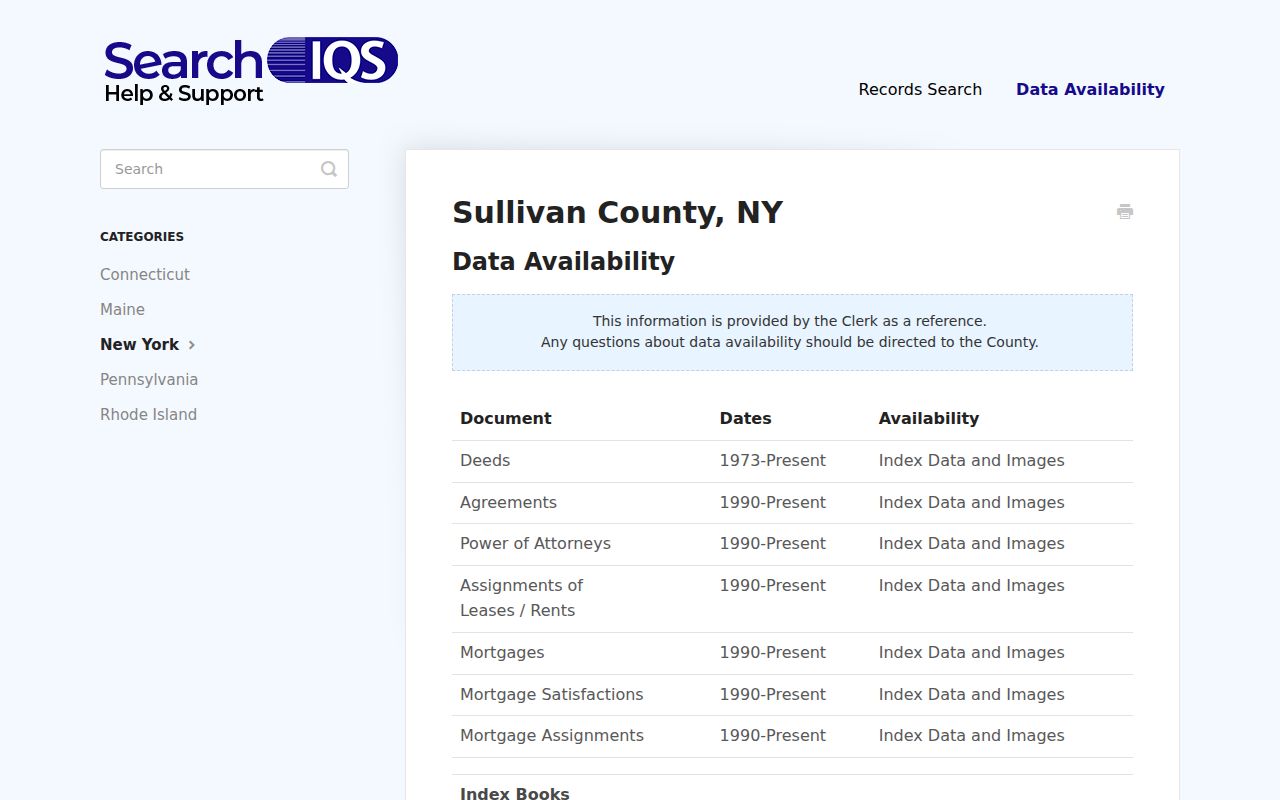
Sullivan County separates two distinct issues: whether a deed index exists online, and whether recorded images can actually be opened.
Recording a Deed in Sullivan County
To record a Sullivan County deed, the Clerk's guidance calls for the original acknowledged instrument plus New York transfer forms such as RP-5217 and TP-584 when applicable. Map filing is its own process, with Mylar and certification requirements. One caution matters here. Acceptance for recording never guarantees the grantor held a complete interest or that no other claim exists on the record. Keep the recorded deed, transfer forms, legal description, and map references together as the parcel's document trail. That trail, not the recording stamp, is the evidence.
Sullivan County Mortgages and Satisfactions
Mortgages, assignments, and satisfactions live in the same Sullivan County land records as deeds but do different work. A loan is not a conveyance. Follow party names and document references closely. Confirm that a satisfaction actually matches the mortgage in question before treating the lien as cleared.
Search Sullivan County Deeds by Party and Date
The Sullivan County search screen offers Party 1 and Party 2 fields, recording-date ranges, town, document group, book and page, instrument number, and case number. Search both sides of the deal, since the role a name carries depends on the instrument. For a purchase deed, start with the apparent owner as grantee. Then take the grantor from that deed and search the same person as an earlier grantee, stepping back through the chain one transfer at a time. Preserve middle initials, trust wording, and business suffixes. Controlled variants help when the exact form stalls.
Recording identifiers separate people who share a name. Sullivan County generally relies on book and page for older recordings and instrument numbers after 2010. Town and legal-description clues can weed out unrelated deeds. The image settles it. Execution, acknowledgment, and recording dates often differ, so cite the recording date when describing when the Clerk accepted the instrument.
Older Sullivan County Deed Books and Indexes
The searchable online index anchors at 1973. SearchIQS county documentation identifies 1973-through-1990 index books among its older holdings. It also lists deed books 1154 through 1396. To push a chain earlier, move to the Clerk's grantor and grantee indexes. Deed volumes, microfilm, and cataloged historical collections can help too. Carry forward the last reliable party name, book and page, town, subdivision, and prior-instrument reference. That gives the older source something to match against.
An image that will not open is not proof of destruction. Sullivan County publishes no courthouse-fire account of lost deeds. Say what is missing and where you looked instead. The Sullivan County Historical Society, local libraries, newspaper microfilm, maps, and directories can bridge a changed name or road. They yield leads, not proof. The recorded conveyance remains the evidence of an ownership transfer.
Deed Recording Forms and Sullivan County Map References
The Sullivan County Clerk wants an original, acknowledged deed. It also needs the right New York transfer forms, chiefly RP-5217 and TP-584. A deed in Sullivan County property records may point to a subdivision plat, an easement, an earlier deed, or a metes-and-bounds description. Pull the referenced map when it helps you pin down the lot. A tax-map line, though, is no stand-in for the deed description or a survey.
Map filing is its own event. It follows separate Mylar and certification rules, so recording a deed does not cover it.
One more caution: recorded consideration is not the same as market value. The figure on a Sullivan County deed may reflect a family sale. It may also reflect a partial interest or some other structure. Treat it as a fact reported with that transfer. For real valuation questions, go to assessment records, the tax roll, or an appraiser.
Sullivan County recorded 4,180 deeds in its 2024 production statistics. That volume is exactly why precise identifiers matter in a deed search. A party name alone can pull up plenty of unrelated instruments. Keep a log of the exact name variant, the date span, the town, the document description, and the result reference for every parcel number and deed you touch.
If nothing matches, widen one field at a time. That way you know which change found the document.